
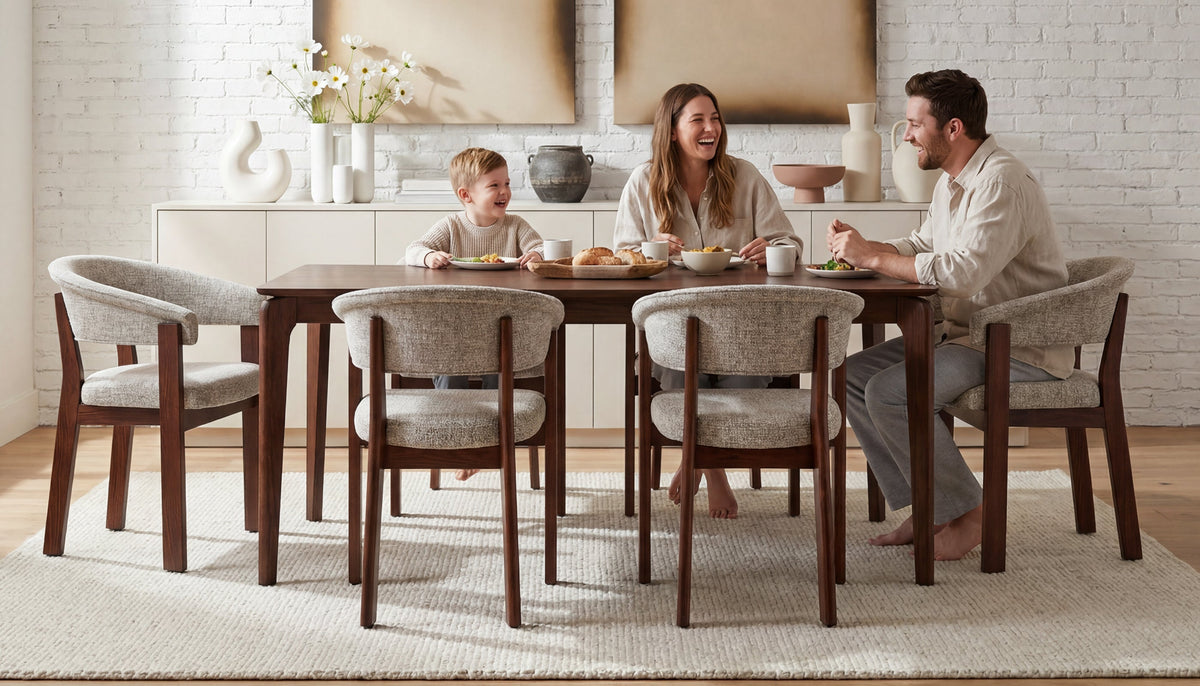
When two dining chairs both look like oak online, it is easy to assume the difference is mostly about colour. In reality, solid oak, oak veneer and oak effect describe different ways of making furniture. Understanding those terms makes it easier to compare quality, care, price and the way a chair will live in your home.
For dining chairs, the frame deserves particular attention. A chair is pulled out, pushed back, moved between rooms and used from more angles than a cabinet or sideboard. What matters is not simply whether the word “oak” appears in the product name, but where the oak is used, how the structure is joined and whether the dimensions suit the table you already own.

Quick answer: what is the difference between solid oak and oak veneer?
Solid oak means the parts described as solid are made from oak through their thickness. Oak veneer uses a thin layer of real oak bonded to another material, often plywood, MDF or a similar engineered core.
Neither label tells you everything about furniture quality. Solid timber is especially easy to understand in chair legs, rails and frames; veneer can be a very sensible choice for wider, flatter furniture panels. Good buying decisions come from matching the material to the job rather than assuming one construction is always superior.
1. What does “solid oak” mean on a dining chair?
A solid oak dining chair uses oak timber through the parts that are described as solid. On a chair, that usually matters most in the visible structural pieces: the legs, side rails, back supports and frame around the seat.
Because timber is a natural material, a set of oak dining chairs will not behave like a printed surface. Grain direction, small tonal changes and the way a stain settles into the wood can vary slightly from chair to chair. Those differences are normal and often part of what makes real timber feel warmer in a room.
The wood species matters too. COLAMY HALO Prime uses an FSC-certified solid red oak frame and legs. The same material specification is used for HALO Luxe, where the frame is additionally joined with traditional mortise-and-tenon construction.

2. What is oak veneer?
Oak veneer is still real oak. The difference is thickness. Instead of using a solid piece of oak all the way through, a thin oak layer is applied over a stable core material.
This construction is widely used for a reason. Large flat pieces of natural timber move slightly as temperature and humidity change. On a cabinet door, sideboard top or broad table panel, a well-made veneered surface can give you real oak grain while helping the panel stay flatter and more consistent.
That makes the familiar “solid wood good, veneer bad” rule too crude to be useful. A better question is: where is the veneer, what is underneath it and is that construction appropriate for that part of the furniture?
On a dining chair, the load-bearing frame is usually the place to focus first. If a retailer describes a chair as oak, look for wording that tells you whether the legs and frame are solid timber, veneered, or simply finished to resemble oak.
What about “oak effect”?
Oak effect is a separate category. It usually means a printed, laminated or textured surface designed to imitate oak. It can be practical and affordable, but it is not the same as oak veneer, because veneer has a genuine wood layer on the surface.
3. Solid oak vs oak veneer: what actually changes?
| What to compare | Solid oak | Oak veneer |
|---|---|---|
| Construction | Oak through the specified part | Thin real-oak surface over a core |
| Grain | Natural variation continues through the timber | Can use selected, visually consistent grain |
| Dimensional stability | Natural timber moves slightly with its environment | Stable cores are useful for broad flat surfaces |
| Surface repair | Often gives more room for careful sanding or refinishing | Heavy sanding can cut through the veneer layer |
| For dining chairs | Look closely at frame, rails, legs and joinery | Check which parts are veneered and what supports them |
Price and weight can differ too, but they are not reliable quality tests by themselves. A wide upholstered solid-oak chair can weigh more than a slim one; a carefully engineered veneered piece can be substantial. Construction details are more useful than assumptions.
4. How to tell what an “oak dining chair” is really made from
When you are shopping online, these five checks are more useful than zooming in on the hero image.
Read the component description
Look for exact wording such as “frame and legs: solid red oak”. “Oak finish”, “oak colour” and “oak look” describe appearance, not necessarily the material underneath.
Separate species from finish
A walnut-coloured chair is not automatically made from walnut. HALO Prime and HALO Luxe, for example, use solid red oak in both the Natural and Walnut options; the Walnut version refers to the finish applied over the oak.
Look at the rear and side views
The front of an upholstered chair can hide much of its structure. Side rails, rear legs, back supports and exposed edges usually tell you more about how the chair is built.
Check the joinery, not only the wood name
Solid timber is only one part of the story. How the frame is connected matters too. HALO Luxe is a useful example because its solid red-oak frame uses mortise-and-tenon joinery and arrives fully assembled.
Use the FAQ when the specification is vague
A good furniture page should answer direct questions such as “Is the frame solid oak or veneer?” If the page uses several different material terms without explaining them, ask before ordering.
5. Why the frame matters so much on a dining chair
Dining chairs are relatively small pieces of furniture, but they work hard. Their narrow legs and rails repeatedly take weight and movement, and the chair is often handled by the backrest rather than left in one place.
This is where solid wood can feel particularly intuitive: the structural parts you touch and see are timber through their thickness. At the same time, the label alone is not enough. A good chair also needs sensible proportions, secure joints and a seat that is properly supported.
In smaller apartments or open-plan rooms, there is a visual benefit too. Exposed oak legs allow more floor to remain visible, while an upholstered seat or back prevents the room from becoming one continuous field of timber.
6. Natural oak or walnut finish: the same wood can change the room
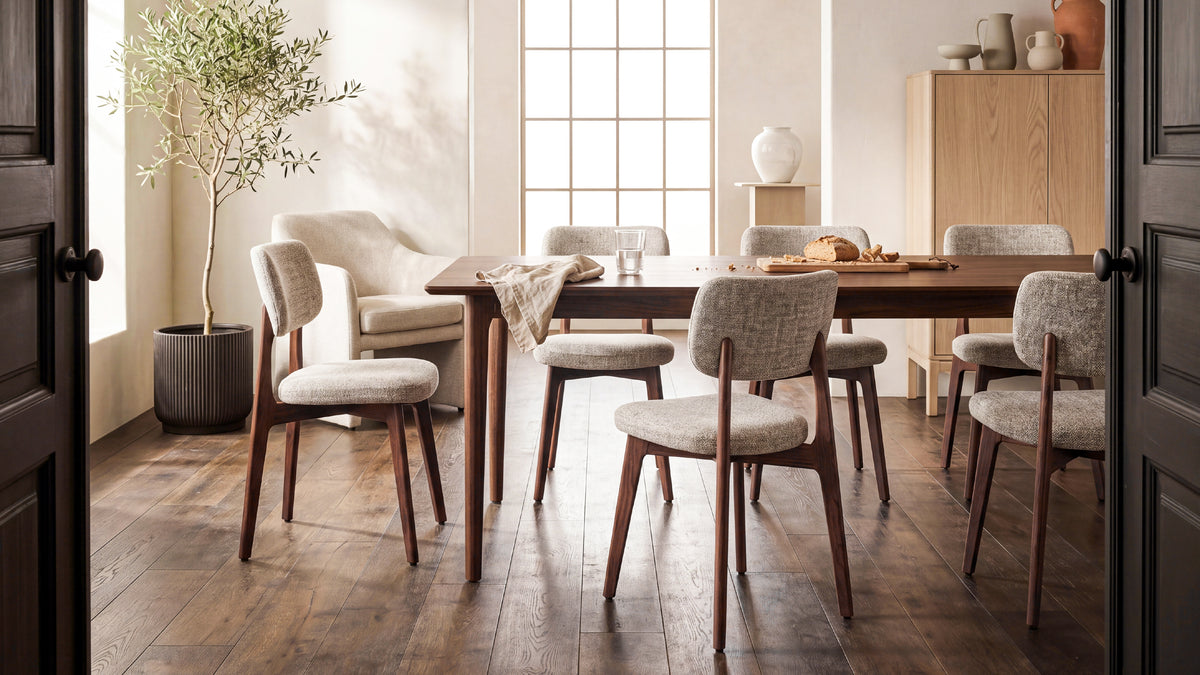
Light oak dining chairs in a Natural finish tend to sit quietly with pale timber, off-white walls, light stone and softer neutral interiors. The grain reads clearly, but the overall effect stays airy.
A walnut-toned finish gives the same oak structure more contrast. It works well when you want dark oak dining chairs visually, but still want the underlying grain to remain part of the design. Beside a pale table, the darker frame creates definition; beside warm darker wood, upholstery can stop the two finishes from feeling overly matched.
The easiest rule is not to chase an exact colour match. Let the wood tones relate, then use fabric as the break between them. If you want more ideas on table shape and colour pairing, our guide to matching dining chairs to a table goes deeper into that decision.

7. What upholstery adds to a solid oak chair
Solid wood dining chairs do not need to be all timber. Upholstery changes both comfort and the visual balance of the frame. It can soften a stone or wooden table, make longer meals feel more relaxed and introduce texture without adding another hard finish to the room.
Both HALO models use a 440gsm mixed-weave polyester fabric across the upholstered sections. The product specification also lists OEKO-TEX Standard 100 certification; HALO Prime is currently listed with 50,000 Martindale abrasion resistance on the EU product page.

HALO Prime: a lighter solid-oak option for a complete table
HALO Prime is the more straightforward set-based option. The solid red-oak frame stays visible beneath a fully upholstered back and padded seat, so it works well when you want modern oak dining chairs without filling the room with too much wood.
It is offered in sets of 2, 4 or 6. The seat height is 50cm and the chair is approximately 47cm wide, which makes it relatively easy to repeat around many standard dining tables once you have checked the space between the table legs. Each chair assembles in about five minutes and supports up to 136kg.

HALO Luxe: solid oak with a broader, fully assembled frame
HALO Luxe takes the same material story in a more enveloping direction. Its solid red-oak frame uses traditional mortise-and-tenon joinery and arrives fully assembled, so the construction itself becomes part of the reason to choose it.
At approximately 60cm across its widest point with a 48cm seat height, it needs a little more space around the table than HALO Prime. It is available individually or in sets of 2, 3 or 4, which also makes it useful if you want a pair of more substantial end chairs rather than six identical seats.
8. Before choosing solid oak, check whether the chair actually fits
Material is only useful if the chair works with the table. As a practical starting point, leave roughly 25–30cm between the top of the seat and the underside of the tabletop or apron. Then measure the usable distance between the table legs rather than relying on the full tabletop length.
HALO Prime is approximately 47cm wide. HALO Luxe reaches about 60cm at its widest point. In a compact dining area, those extra centimetres can make a noticeable difference to circulation and how easily the chairs tuck in.
For a six-seat rectangular table, a useful alternative to six wide chairs is to keep narrower chairs along the sides and use the broader chairs at the ends. That gives the table some variation without making every place setting equally wide.
9. Are solid oak dining chairs worth choosing?
They can be, especially when the chair is intended for the dining space you use every day. Solid oak gives you visible natural timber in the structural parts and generally gives more scope for careful surface repair than a thin veneer.
But the useful answer is not “solid oak is always best”. A well-made veneered cabinet or table panel may be exactly the right construction for that piece. Even with chairs, the quality of the joints, seat support and finish still matters. Choose solid oak because it suits the structure and the way you want the furniture to age, not simply because the label sounds more expensive.
10. How to care for solid oak and upholstered dining chairs
For a finished oak frame, everyday care is simple: remove dust with a soft cloth, wipe spills promptly and avoid leaving standing moisture on the timber. Abrasive cleaners can damage the finish, and prolonged direct heat or strong sunlight can gradually change both wood and fabric.
For upholstery, vacuum gently with a soft brush attachment and blot spills instead of rubbing them deeper into the weave. The exact cleaning method should always follow the chair’s own care instructions, especially because lacquered, oiled and waxed wood finishes are not maintained in exactly the same way.

Frequently asked questions
Is oak veneer real wood?
Yes. Oak veneer has a thin layer of genuine oak on the surface. The material underneath is usually an engineered core such as plywood or MDF. Oak effect is different because it may simply reproduce the appearance of oak.
Is solid oak better than oak veneer?
Not in every application. Solid oak is especially intuitive for chair legs, rails and visible structural frames. Veneer can be a very practical choice for large flat panels because a stable core helps control movement. Quality depends on the complete construction, not one material word.
Does “walnut finish” mean the chair is walnut?
No. On HALO Prime and HALO Luxe, Walnut describes the darker finish over a solid red-oak frame. The Natural option uses the same red-oak structure with a lighter appearance.
Can oak veneer be sanded?
Only very carefully. Because the real-oak layer is thin, aggressive sanding can cut through it. Solid timber usually offers more depth for surface repair, although refinishing still needs to suit the original coating.
What is the difference between solid oak and solid red oak?
“Solid oak” describes how the part is constructed: oak timber through its thickness. “Red oak” describes the oak species. A chair can therefore be both solid oak and specifically solid red oak.
Are upholstered solid oak dining chairs practical for everyday use?
They can be. The timber frame provides the visible structure while upholstery adds softness and comfort. For daily use, also check the fabric specification, care instructions, seat dimensions and how much room the chair needs around the table.
How much clearance should there be between a dining chair and table?
A useful starting point is around 25–30cm from the top of the seat to the underside of the tabletop or apron. Also check the chair’s widest point against the distance between the table legs.
The simplest way to choose
If you are comparing solid oak and oak veneer dining chairs, read the construction from the inside out: frame first, joints second, finish third, dimensions before checkout. Veneer is genuine wood and has useful applications; solid oak gives you timber through the structural part and can be particularly well suited to the exposed frame of a dining chair.
For COLAMY HALO Prime and HALO Luxe, the material story is the same at its foundation: FSC-certified solid red oak paired with textured upholstery. The choice between them is then about scale and construction — a narrower set-based chair that assembles quickly, or a broader fully assembled chair with traditional joinery.
Explore: COLAMY EU Dining Chairs
Next read: How to Match Dining Chairs to a Table

Leave a comment
This site is protected by hCaptcha and the hCaptcha Privacy Policy and Terms of Service apply.