
A dining table often stays in a home longer than the chairs around it. You may have inherited a solid oak table, chosen a compact round table for an apartment, or simply want to make an existing dining area feel softer and more considered. In each case, the useful question is not “Which chair matches this table exactly?” It is “What makes the table and chairs feel as though they belong together?”
The answer comes down to fit first, then visual connection. Get the height, width and clearance right. After that, repeat one detail from the table — a warm wood tone, a curve, a colour or a design mood — and deliberately change another. That small amount of contrast is what keeps a dining room from feeling like a showroom set.

Quick answer: how do you match dining chairs to a table?
Start with measurements. Aim for roughly 25–30 cm between the top of the compressed chair seat and the underside of the table or apron. Check the usable space between the table legs, not just the tabletop length, and leave enough width for each person to sit without their elbows meeting the next chair.
Then make the table and chairs visually related without making them identical. A simple formula is: anchor, echo, contrast. Let the table be the anchor, echo one of its features in the chairs, and use upholstery, shape, finish or colour to create contrast.
1. Get the fit right before the look
A beautiful chair that pinches your thighs against the table apron is not a good match. Before thinking about fabric colours or wood finishes, check the dimensions that determine whether the chair will actually work.
Seat-to-table clearance
Measure from the top of the seat — ideally with the cushion slightly compressed — to the underside of the tabletop or table apron. Around 25–30 cm is a useful target for comfortable legroom. The underside measurement matters because a deep apron can turn a seemingly standard dining table into a surprisingly tight fit.
Chair width and usable table space
Measure the clear distance between the table legs. A 180 cm tabletop does not always provide 180 cm of seating space if the legs are set in from the corners. As a practical starting point, allow about 55–60 cm of table edge per person, and more for wider upholstered chairs or chairs with arms.
Pull-out space
Think beyond the chair when it is tucked in. In a smaller dining room or apartment, you also need room to pull the chair back and walk behind it. Marking the chair footprint on the floor with masking tape is a simple way to understand the real space before ordering.
A useful example is the COLAMY NOYA Mid-Century Modern Dining Chair. Its current size guide lists a seat height of about 49 cm (19.29 in) and shows it with standard dining tables around 74–79 cm high. Its curved upholstered back also gives support without creating the visual bulk of a fully enclosed chair.

2. Read the table before choosing the chair
Instead of starting with a chair you like in isolation, take three seconds to read the table in front of you.
First, look at visual weight. Is the table chunky and architectural, or slim and light? A heavy pedestal or trestle table usually benefits from chairs with some openness around the legs or back. A very slim table can carry a fuller upholstered chair without feeling crowded.
Second, look at the dominant line. Round and oval tables already have movement, while rectangular tables create a stronger horizontal rhythm. Your chair can either repeat that line or gently counter it.
Third, notice the surface and undertone. Pale oak, dark walnut, black metal, glass and stone all set a different mood. You do not need to match the finish exactly; you only need a deliberate relationship between the two pieces.
This way of reading the table is especially useful if you are shopping online, where a chair can look perfectly proportioned on its own but feel very different once placed around a table.
3. Use the Anchor, Echo & Contrast rule
When you are unsure how to match chairs with a table, use three steps.
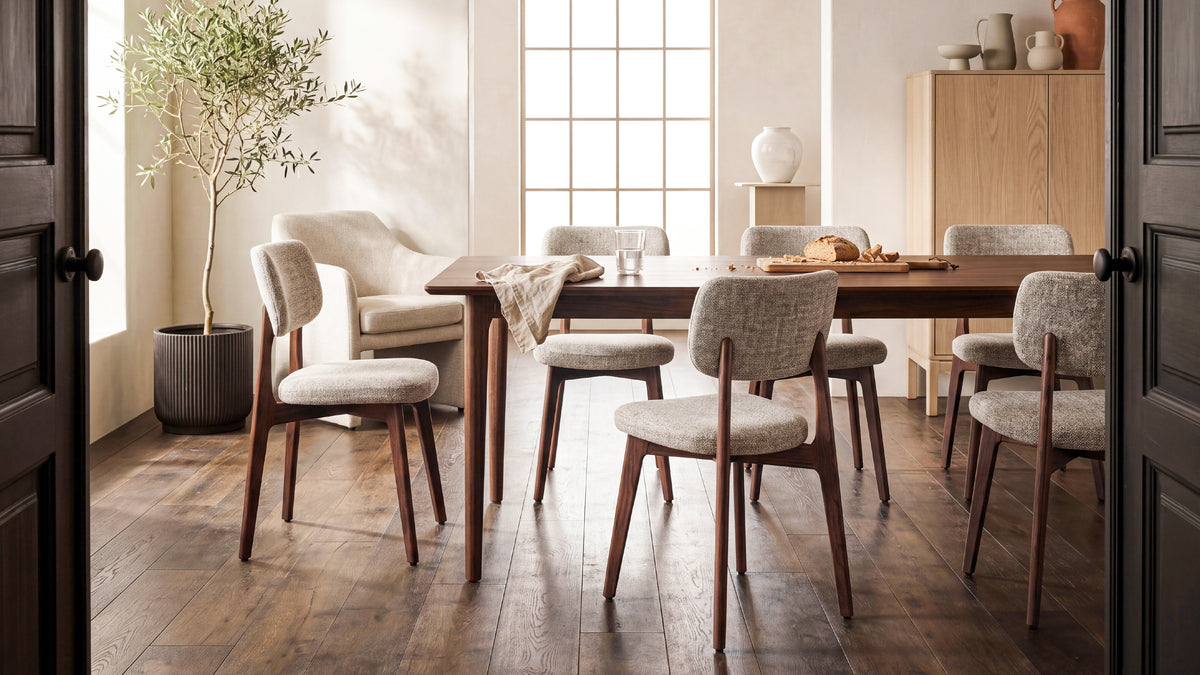
The COLAMY HALO Prime is a good example of this balance. Its FSC-certified solid red-oak frame can echo a timber table, while the fully upholstered seat and back introduce a noticeably softer surface. Natural and walnut-toned frame options make it possible to either stay close to the table’s warmth or create a clearer tonal difference.

4. How to match chairs to different table materials
Chairs for a wooden or oak table
A wooden chair for a dining table can work beautifully, but trying to match two wood stains exactly is often harder than it sounds. Different batches, grains and lighting can make “almost the same” look accidental.
Instead, choose one of two directions. Either keep the wood undertone related and introduce upholstery, or make the frame deliberately lighter or darker than the table. For a natural-oak table, oatmeal, beige, light grey and other soft textiles keep the room warm without adding more visual timber. With a dark wood table, lighter upholstery or a natural-oak frame can stop the arrangement feeling too heavy.
HALO Prime works well in this situation because the solid red-oak frame maintains the timber connection while the mixed-weave upholstery creates separation. If you want the chair to feel more substantial, HALO Luxe uses the same warm wood-and-upholstery language in a more enveloping silhouette.
Dining chairs for a glass table
Glass is visually light, so the chairs do more of the work in setting the mood. Warm wood frames and textured upholstery make a glass table feel more relaxed and residential. Slim black frames create a sharper, more architectural look.
Because the chair structure remains visible through the tabletop, pay attention to the chair from the back and side as well as the front. Clean joinery and a considered rear profile matter more here than they do with an opaque table.
Chairs for a marble or stone table
Stone already brings pattern and visual weight. Upholstered dining chairs are a natural counterpoint because they soften the hard surface and make the room feel less formal. Warm wood, oatmeal, beige or muted grey fabrics work especially well with pale stone; darker upholstery can give a heavily veined marble top a more graphic feel.
If the table has strong veining, let it be the pattern in the room. A quieter fabric usually feels calmer than adding another bold textile.
Chairs for a black or metal table
A black table does not require black chairs. In fact, natural timber and warm upholstery are often what keep the dining area from feeling severe. If you do choose dark chairs, bring in softness through fabric, a rug, curtains or warm lighting.
Another easy approach is to repeat black only in a small detail elsewhere — a pendant, cabinet handle or picture frame — and keep the chair itself in a warm neutral.
Chairs for a white or pale table
Pale tables give you the most freedom. Natural oak keeps the look airy; walnut adds contrast; muted blue, green, camel or grey upholstery can add personality without making the dining area feel busy.
For compact spaces, keep the chair legs visible and avoid too many bulky forms at once. A pale table plus open timber frames can make the whole setting feel lighter.
| Table finish | Chair direction | Use carefully |
|---|---|---|
| Oak or timber | Upholstery, woven texture, natural or darker wood contrast | Near-identical stains with no textural break |
| Glass | Warm wood, upholstery, clean rear profile | Visually messy frames |
| Marble or stone | Soft upholstery, warm timber, quiet textiles | Too many competing patterns |
| Black or metal | Cream fabric, natural wood, warm texture | Flat all-black schemes without softness |
| White or pale | Oak, walnut or muted colour | Pale-on-pale with no tonal variation |
5. Match chair shape to table shape
Round tables
Round tables already create a social, conversational feel. Chairs with a curved or gently wrapped back repeat that movement and make the setting look composed without feeling overly matched.
For smaller round tables, armless or visually open chairs are easier to tuck in. A pedestal base gives even more flexibility because there are no corner legs competing with chair placement.
The curved back of the COLAMY NOYA is particularly easy to use with a round or oval table: the silhouette follows the table’s movement, while the wooden frame keeps the chair visually light enough for a compact setting.

Rectangular tables
Rectangular tables create repetition naturally. Four or six matching side chairs give a calm rhythm, but this shape is also the easiest place to use different end chairs.
A useful 4+2 arrangement is four simpler side chairs with two slightly more substantial chairs at the ends. Keep the wood tone, upholstery family or back height connected so the difference feels planned.
Oval tables
An oval table has the length of a rectangle without the hard corners. Curved chair backs feel harmonious here, while straight timber legs keep the scheme from becoming too soft. Leave enough room at the curved ends so end chairs do not crowd the side chairs.
Square tables
A square table is already compact and symmetrical, so four matching chair silhouettes are often the cleanest choice. The chairs do not need to match the table finish, though. In fact, changing the material or colour is an easy way to stop a four-seat setup from feeling overly uniform.
6. How to mix and match dining chairs without making the room feel random
Mismatched dining chairs work when the eye can spot the rule behind them. You do not need every chair to match; you need a visible reason why they belong together.
The 4+2 formula
For a six-seat rectangular table, use four matching side chairs and two different end chairs. This gives you contrast without losing the calm repetition along the sides.
A natural COLAMY pairing is HALO Prime on the sides with HALO Luxe at the ends. Both use solid red-oak frames and textured upholstery, so the material story is related, while the Luxe has a more enveloping shape that gives the ends extra presence. Because HALO Luxe is offered from a single chair upwards, this approach does not require buying a complete second set.

One chair, different colours
If you like colour but not visual clutter, keep the chair silhouette the same and vary the upholstery. Two or three related shades are easier to live with than six unrelated colours. Warm neutrals can be mixed with one muted accent for a look that still feels grown-up.
Two styles, similar visual weight
Different chairs can sit comfortably together when their back heights and overall visual weight are close. A very delicate chair beside an enormous, fully enclosed chair usually feels unbalanced. A light timber frame beside a neatly upholstered chair of similar height feels much more intentional.
Keep the style vocabulary narrow
A dining table with different chairs does not need to represent every design style in the room. Two broad languages are usually enough — for example Scandinavian plus mid-century, or modern plus farmhouse. Once the table and chairs are already mixing several strong styles, adding another can make the room feel unresolved.
7. Make the pairing work in smaller European spaces
Many dining areas have to do more than host dinner. They sit in open-plan kitchens, share space with a living room, double as a desk during the week or occupy one end of an apartment. In these rooms, scale is often more important than making a dramatic statement.
Choose chairs that tuck in easily
A chair may have a modest seat but a wide back that takes up more room than expected. Check the widest point of the chair and the position of the table legs. Curved, armless profiles are often easier to arrange around compact tables.
Protect the circulation path
Before ordering, pull your existing chair back as if someone were getting up and measure the remaining walkway. If the room already feels tight, choosing a slightly narrower chair can improve daily life more than adding an extra seat.
Use visual lightness
Visible legs, open sides and a little floor showing between pieces keep a small dining area from feeling blocked. Upholstery can still work beautifully; the key is pairing softness with a frame that does not read as a solid mass.
Do not force six seats into a four-seat room
If six chairs technically fit but nobody can move around them comfortably, the table will always feel crowded. Buy for the way the room is used most days, then keep occasional extra seating elsewhere if needed.
8. What if the dining area includes a kitchen island?
Open-plan kitchens often combine a standard dining table with counter-height seating. The matching principle stays the same, but the seat height changes completely.
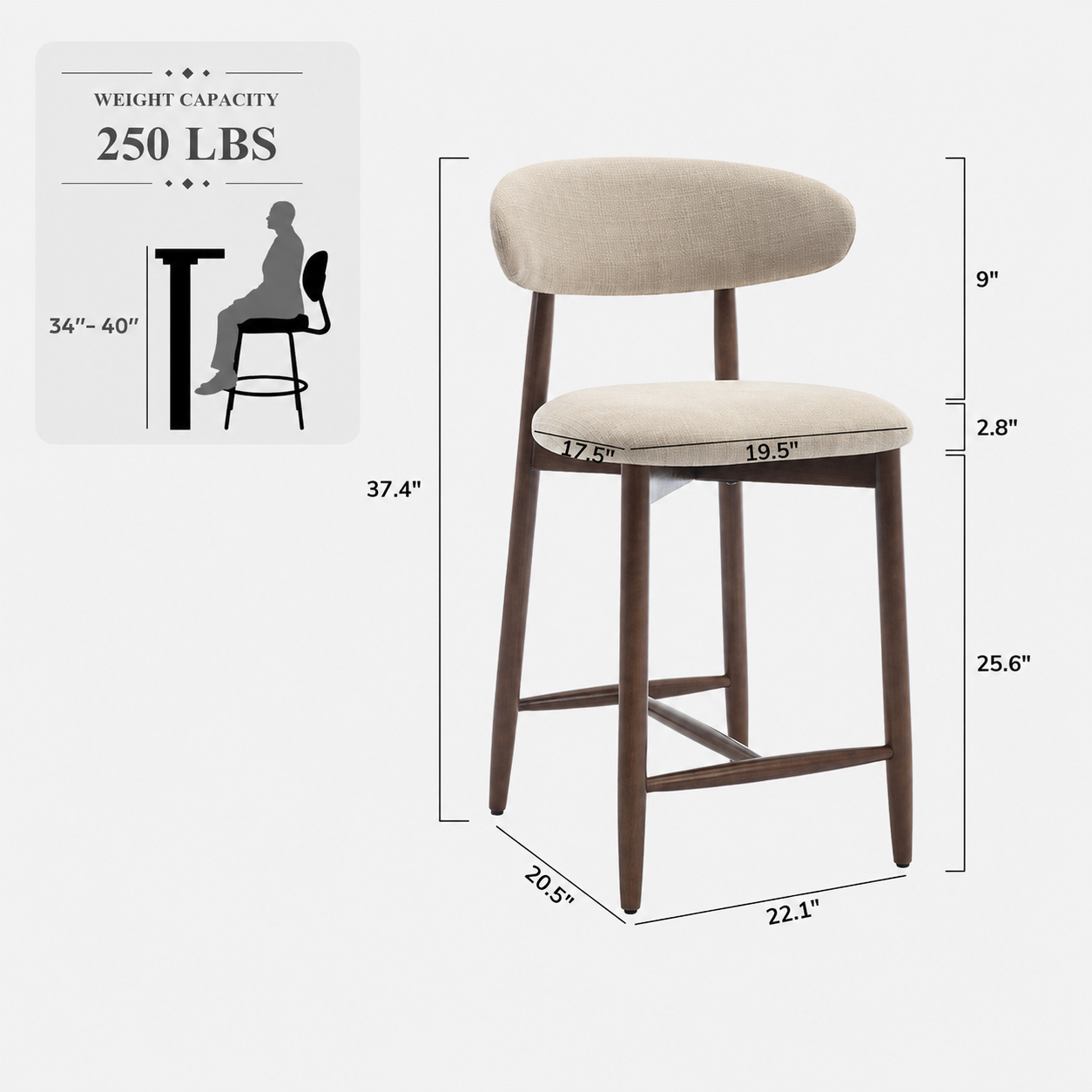
The current COLAMY ARLA size guide shows a seat height of 25.6 in, or about 65 cm. That places it in the counter-height category rather than standard dining-chair height. It is designed for kitchen islands and higher counters, so it should not be substituted for a normal dining chair at a 74–79 cm table.
For an island, measure from the floor to the underside of the worktop and aim for the same roughly 25–30 cm of seat-to-surface clearance. Also check the worktop overhang so there is enough room for knees.
Visually, ARLA’s curved upholstered back and wooden frame make it easy to connect the kitchen seating with upholstered dining chairs nearby. Instead of matching the two seating zones exactly, repeat the warm timber or fabric tone so the open-plan space feels coherent.

9. Let the rest of the room finish the match
The table and chairs are only part of the picture. Flooring, rugs, lighting and nearby cabinetry can make a pairing feel either balanced or repetitive.
If your floor, table and chair frames are all similar timber tones, break the sequence with upholstery or a rug. If the table and chairs are high contrast, repeat each finish once elsewhere: a black table can connect to a black pendant, while natural-oak chair frames might echo a sideboard or kitchen shelf.
A rug should be large enough for the chair legs to remain on it when the chairs are pulled out. A rug that catches the back legs every time someone sits down quickly becomes irritating, no matter how good it looks in a photograph.
Lighting can also mediate between shapes. A round pendant softens a rectangular table; a linear light reinforces its length. If your furniture is mostly angular, one curved element is often enough to make the room feel less rigid.
10. Common dining chair and table matching mistakes
Trying to match wood stains exactly. Near-matching wood can look more accidental than deliberate contrast. If the stains are not genuinely the same, create a clear difference and connect the pieces with upholstery or another repeated detail.
Ignoring the table apron. Overall table height alone is not enough. Always measure the underside, especially if the table has a deep frame or decorative apron.
Buying by colour alone. Two beige pieces can still look wrong together if one is visually tiny and the other extremely bulky. Proportion comes before palette.
Using too many unrelated styles. Mixing works best when there is a rule. If every chair introduces a new shape, colour, material and period, the room can feel more accidental than collected.
Choosing the wrong seat height. Counter-height seating such as ARLA is for islands and counters, not a standard dining table. A 15 cm difference in seat height changes the whole sitting position.
Overfilling the table. Do not assume the tabletop length tells you how many chairs fit. Table legs, chair width and elbow room all reduce the usable space.
Forgetting everyday comfort. A dining chair has to work after the photograph is taken. If the table is used for long meals, homework or working from home, back support and seat comfort deserve as much attention as the silhouette.
11. A quick checklist before you buy
- Measure from the floor to the underside of the table, not just the top.
- Aim for roughly 25–30 cm between the chair seat and the underside of the table.
- Measure the clear space between table legs.
- Allow roughly 55–60 cm of table edge per person, more for wider chairs.
- Check the widest part of the chair, including the back or arms.
- Make sure there is enough room to pull the chair out and walk behind it.
- Decide what the chair will echo: wood undertone, colour, curve, leg finish or design mood.
- Add deliberate contrast through upholstery, shape, finish or shade.
- Check fabrics and wood finishes in both daylight and evening light.
- If you are mixing chairs, keep at least one visible feature consistent.
- Choose for the way the dining area is genuinely used most days.
12. Frequently asked questions
Do dining chairs have to match the dining table?
No. Dining chairs usually look more considered when they coordinate with the table rather than match it exactly. Repeat one feature — such as a warm wood tone, curve, colour or design style — and change another through upholstery, finish or shape.
How do I match chairs with a wooden table?
With a wooden table, avoid relying on an almost-identical stain. Use upholstered seats, woven texture, a clearly lighter or darker wood frame, or a contrasting neutral. For an oak table, beige, oatmeal, light grey and muted colours are easy ways to add softness without fighting the grain.
Can I mix and match dining chairs around the same table?
Yes. The simplest approach is four matching side chairs with two different end chairs. You can also use one chair shape in different colours, or two chair styles with similar back heights and visual weight.
Can dining room chairs be different colours?
Yes. Keeping the silhouette the same makes different colours feel intentional. Two or three related shades usually create a calmer result than using a different colour on every chair.
What dining chairs work with a glass table?
Glass tables work well with chairs that add warmth and definition, such as upholstered seats, clean solid-wood frames or slim dark silhouettes. Because the chair frame remains visible through the glass, choose a design that looks good from the back and side as well as the front.
How much space should there be between a dining chair seat and the table?
Around 25–30 cm between the top of the seat and the underside of the table is a practical target. Always measure the table apron, not only the tabletop height.
Can I mix different wood tones in a dining room?
Yes. Wood tones do not need to be identical. They look intentional when their undertones are compatible or the contrast is clear. Repeating one wood tone elsewhere in the room — in shelving, a sideboard or lighting detail — can help connect the scheme.
What chairs are best for a small dining room?
Look for a chair that is comfortable but visually light: an armless profile, visible legs and a back that does not extend far beyond the seat. Round tables and curved chairs can also improve movement in tight spaces because there are fewer hard corners.
Can I use counter stools at a normal dining table?
No. Counter-height stools are significantly taller than standard dining chairs. Always match the seat height to the surface height and keep roughly 25–30 cm of clearance between the seat and the underside.
Should the chairs at the ends of a dining table be different?
They can be, but they do not have to be. Different end chairs are an easy way to add interest to a rectangular table. Keep one feature connected to the side chairs — material, colour, wood tone or overall height — so the change looks deliberate.
A dining room feels best when the furniture has a relationship, not a uniform. Start with fit, let the table anchor the room, repeat one visual idea and leave enough contrast for each piece to have its own character.
That approach works whether you are furnishing a compact apartment table, a long family dining table or an open-plan kitchen with two different seating heights.

Leave a comment
This site is protected by hCaptcha and the hCaptcha Privacy Policy and Terms of Service apply.